EX-1.05
retour
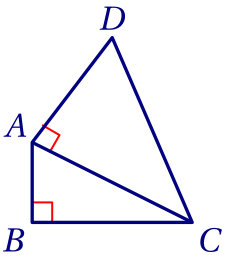
De plus, on sait que la droite $(AC)$ est la bissectrice de l'angle $\widehat{BCD}$.
1. Calculer la longueur $AC$ arrondie au millimètre près.
Corrigé
Puisque le triangle $ABC$ est rectangle en $B$:
\[\begin{aligned}
\cos\widehat{ACB} &= \frac{BC}{AC}&
\\ \implies
AC &= \frac{BC}{\cos\widehat{ACB}} = \frac 4 {\cos 30°} \approx 4,6\:\text{cm}.&
\end{aligned}\]
2. Calculer la longueur $AD$ arrondie au millimètre près.
Corrigé
$(AC)$ est la bissectrice de l'angle $\widehat{BCD}$, donc
\[\widehat{ACD}=\widehat{ACB}=30°.\]
D'autre part, puisque le triangle $CAD$ est aussi rectangle en $A$:
\[\begin{aligned}
\tan\widehat{ACD} &= \frac{AD}{AC}&
\\ \implies
AD &= AC \times \tan\widehat{ACD} \approx 4,6 \times \tan 30° \approx 2,7\:\text{cm}.&
\end{aligned}\]
retour
code : 1522